
In short: Well-made composite bonding typically lasts 5 to 8 years before needing attention, and often considerably longer: large clinical studies report over 90% of work surviving at five years, and gap closures lasting up to 17 years. Lifespan depends on the type of case, whether you grind your teeth, and the skill of the placement. Bonding is not permanent, but unlike most alternatives it is designed to be repaired rather than replaced.
Listen to this guide
- Typical quoted lifespan: 5 to 8 years, often longer
- Five-year survival in studies: over 90% for well-placed conventional composite
- Gap closures: 96% survival across an average of seven years, with cases followed for up to 17 years
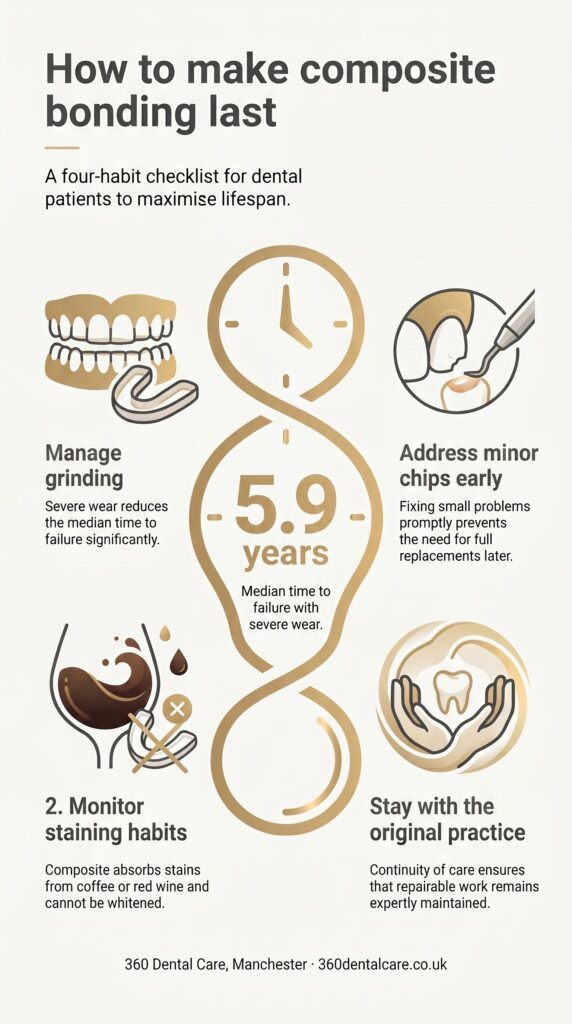
- Heavy grinders: median 5.9 years without protection, so a nightguard matters
- Repairable: small chips and wear are fixed in one visit, without starting again
You will read “5 to 8 years” almost everywhere composite bonding is discussed, and as a typical answer it is fair. It is also incomplete. At 360 Dental Care we have composite bonding still looking great 17 years after it was placed, and the clinical literature backs up that this is achievable rather than lucky. This article gives you the honest numbers, what they depend on, and the 17-year case itself.
How long does composite bonding last on average?
The strongest data comes from studies that follow real patients for years. Conventional composites placed with multi-step adhesive techniques show better than 90% survival at five years. Over ten years, around 60% or more of restorations survive when the right materials are applied correctly, with front-tooth work in the simpler categories reaching 73% to 100% in prospective studies.
The figure that matters most for cosmetic bonding is this one: composite used to close gaps between front teeth, one of the most common cosmetic uses, showed a 96% cumulative survival rate across an average of seven years of follow-up, with individual cases in the study lasting up to 17 years. Direct composite veneers sit at around 91% survival over follow-up periods of two to eight years.
So the honest answer: plan for 5 to 8 years as a sensible baseline, and expect well-chosen, well-placed work to beat it, sometimes by a long way.
What does composite bonding look like after 5 years?
If the work was done well, often much like it did in year one, with perhaps some surface polish lost and a touch-up appointment somewhere along the way. The complications that do show up at this stage are mostly cosmetic and mostly fixable: staining at the edges, surface roughness, and a gradual dulling of the finish lead the list. These are polish-and-repair jobs, not start-again jobs.
Bonding that was done badly tells a different story by year five: bulky margins that have trapped plaque, staining lines where the join was never properly finished, and chips at edges that were built without respecting the bite. That difference is the subject of our guide to composite bonding costs, because the gap between cheap bonding and good bonding is precisely the gap between these two five-year outcomes.
Is composite bonding permanent?
No, and it is worth being precise about what that means. No cosmetic dental work is permanent: everything in the mouth wears, because the mouth is a harsh environment. The question that actually matters is what happens when work needs attention.
Composite bonding is designed to be repaired. A chipped edge or a stained margin is usually fixed in a single visit by adding and re-polishing material, without removing the original work. Porcelain alternatives are often quoted as running longer between interventions, but when they fail they are generally replaced rather than repaired, and bonding has one further advantage: because nothing is drilled away to place it, your natural teeth underneath stay intact.
The long-term evidence shows what repairability is worth. In a practice that followed its own composite work for up to 33 years, 73% of restorations were still functioning when repair was used to maintain them, against 48% if you only count work that never needed touching. Maintained bonding keeps going.
What makes bonding last, or fail early?
Four factors separate the 17-year cases from the 3-year ones.
- The type of case. Closing a gap or refining an edge is kind territory for composite: the 96% figure above belongs to gap closures (Kim et al., 2026). Rebuilding a badly broken corner of a front tooth is the hardest job composite does, with ten-year survival as low as 56.3% in one review (Kubo, 2010).
- Grinding. Bonding in mouths under heavy grinding load wears and fractures sooner; in patients with severe tooth wear the median time to any failure was 5.9 years, although major failures took over 11 years on average (Shah et al., 2024). If you grind, a nightguard is not an upsell, it is the difference between those numbers and better ones.
- Placement quality. Materials handled with the right technique, margins finished properly, and the bite respected will last longer than quickly placed and poorly executed bonding.
- Maintenance. Failure modes at the margins develop slowly and repair easily when caught early (Lim et al., 2023; Blum et al., 2014). Regular reviews with the practice that placed the work keep small problems small.
How long does the treatment itself take?
Usually one visit. Bonding is sculpted directly onto the teeth, so there is no laboratory wait and nothing temporary to live with in between. Larger smile makeovers may be planned across more than one appointment, which is agreed at consultation.
So, should you expect 5 years or 17?
Plan on 5 to 8 years and treat anything beyond it as the return on choosing well: the right case, the right technique, a nightguard if you grind, and a practice that maintains its own work. The evidence and our own chairs say the same thing: composite bonding done properly is not a short-term fix, it is a long-term result with a simple maintenance plan attached.
If you want to know if composite bonding is a good option for you why not start with a free Smile Report or book a consultation. If bonding is not the right answer for your teeth, we will tell you that too.
FAQs
How long does composite bonding last on average?
Plan for 5 to 8 years as a sensible baseline. Clinical studies report over 90% of well-placed conventional composite surviving at five years, and gap closures lasting up to 17 years.
Is composite bonding permanent?
No cosmetic dental work is permanent. Bonding is designed to be repaired rather than replaced: chips and staining are usually fixed in a single visit without removing the original work, and your natural teeth underneath stay intact.
What does composite bonding look like after 5 years?
Well-placed bonding usually still looks natural at five years, perhaps with some polish lost. The most common issues by this stage are edge staining and surface roughness, both of which are repairable in one visit.
How long does composite bonding take to do?
Usually one visit. The composite is sculpted directly onto the teeth, so there is no laboratory wait. Larger smile makeovers may be planned over more than one appointment.
Does composite bonding last as long as veneers?
Porcelain veneers are often quoted as running longer between interventions, but when they fail they are generally replaced rather than repaired. Bonding is repaired throughout its life and requires no drilling of the natural tooth to place.
References
- Blum, I.R., Lynch, C.D., Wilson, N. (2014). Factors influencing repair of dental restorations with resin composite. Clinical, Cosmetic and Investigational Dentistry. https://doi.org/10.2147/ccide.s53461
- da Rosa Rodolpho, P.A., Rodolfo, B., Collares, K., Correa, M., Demarco, F., Opdam, N., Cenci, M., Moraes, R. (2022). Clinical performance of posterior resin composite restorations after up to 33 years. Dental Materials. https://doi.org/10.1016/j.dental.2022.02.009
- Fernandez, E., Chaple Gil, A., Caviedes, R., Diaz, L., Bersezio, C. (2025). Clinical longevity of direct dental restorations: an umbrella review of systematic reviews. Journal of Esthetic and Restorative Dentistry. https://doi.org/10.1111/jerd.70052
- Kim, Y., Kang, Y., Jeon, M.-J., Shin, Y., Shin, S.-J., Park, J.-W. (2026). Clinical performance of direct composite resin for anterior space closure: a retrospective evaluation. Journal of Dentistry. https://doi.org/10.1016/j.jdent.2026.106505
- Kubo, S. (2010). Longevity of resin composite restorations. Japanese Dental Science Review. https://doi.org/10.1016/j.jdsr.2010.05.002
- Lim, T., Tan, S.K., Li, K., Burrow, M. (2023). Survival and complication rates of resin composite laminate veneers: a systematic review and meta-analysis. Journal of Evidence-Based Dental Practice. https://doi.org/10.1016/j.jebdp.2023.101911
- Shah, S., Hemmings, K., Gulamali, A., Petrie, A., Malik, J.S. (2024). The survival and clinical performance of anterior composite resin restorations and posterior indirect and cast restorations used to treat generalised tooth wear. British Dental Journal, 237, 203–211. https://doi.org/10.1038/s41415-024-7617-z